SEO Title: Navratri 2026: 9 Days, Significance, Puja & Celebrations
SEO Title: Navratri 2026: 9 Days, Significance, Puja & Celebrations SEO Title: Navratri 2026: 9 Days, Significance, Puja & Celebrations Meta Description: Discover Navratri 2026,
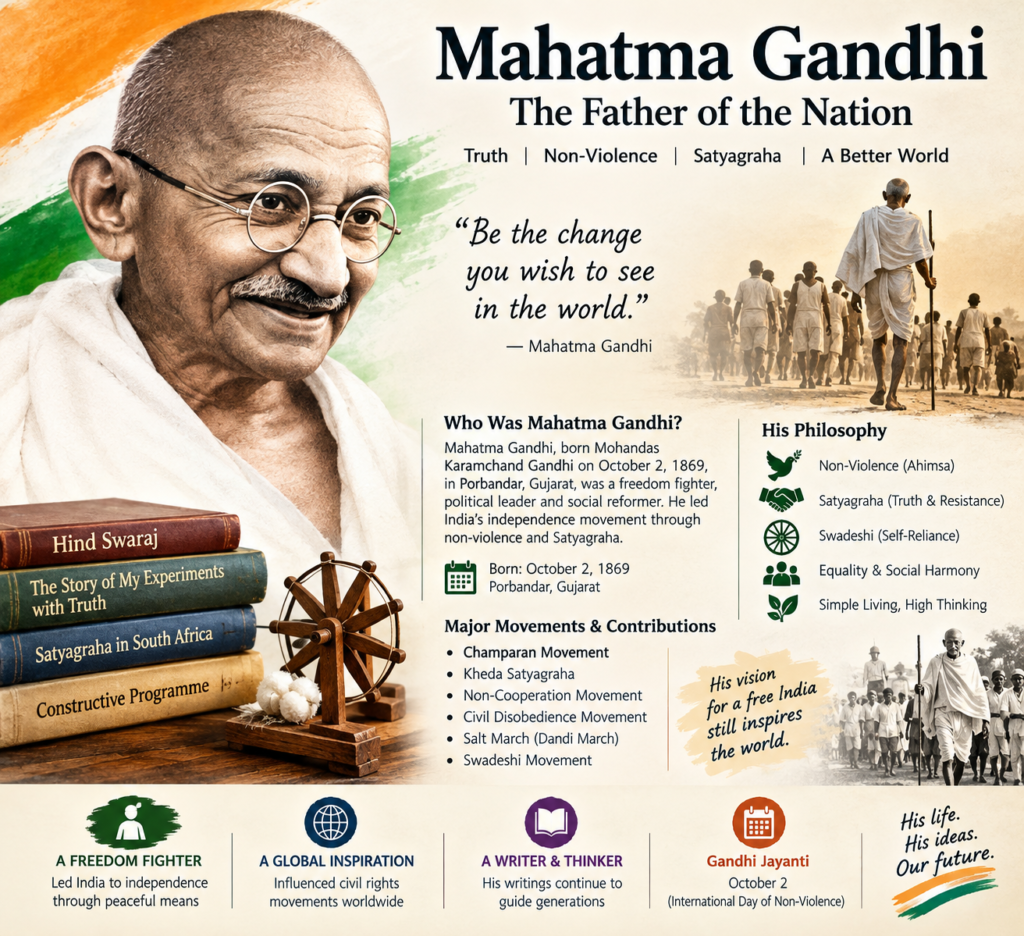
Mahatma Gandhi Jayanti is celebrated every year on October 2 to mark the birth anniversary of Mahatma Gandhi, one of the most important leaders of India’s freedom movement. The day reminds us of Gandhi’s life, his contribution to India’s independence, and the values he promoted throughout his life, including truth, non-violence, peace, simplicity, equality, self-discipline, and service to society.
Gandhi Jayanti is a national occasion in India, but its message goes beyond India. Gandhi’s philosophy of non-violence has influenced people and movements around the world. October 2 is also observed internationally as the International Day of Non-Violence.
In today’s rapidly changing world, Gandhi Jayanti gives us an opportunity to stop and think about how values such as honesty, kindness, peaceful communication, and social responsibility can be applied in our everyday lives.
Mahatma Gandhi was born on October 2, 1869, in Porbandar, Gujarat. His full name was Mohandas Karamchand Gandhi. He came from a family connected with public service and grew up in an environment where values such as honesty and responsibility were important.
Gandhi later travelled to London to study law. After completing his studies, he returned to India and eventually went to South Africa for professional work.
His experiences in South Africa had a major impact on his life. He faced racial discrimination and witnessed unfair treatment of people based on their identity. These experiences encouraged him to think deeply about justice, equality, and peaceful resistance.
When Gandhi returned to India, he became increasingly involved in the country’s freedom movement. He encouraged people to participate in peaceful protests and movements against British rule.
His approach was based heavily on Satyagraha, a philosophy associated with truth and non-violent resistance.
October 2 is celebrated as Gandhi Jayanti because it is the birth anniversary of Mahatma Gandhi.
The day is observed across India through educational programs, cultural activities, speeches, cleanliness drives, community service, and remembrance ceremonies.
Government institutions, schools, colleges, and many organizations organize special programs to discuss Gandhi’s life and teachings.
People also remember his contribution to India’s freedom struggle and reflect on the values he promoted.
Gandhi Jayanti is therefore more than simply a birthday celebration. It is a day for remembering a historical figure and thinking about the principles associated with his life.
Mahatma Gandhi became one of the central leaders of India’s freedom movement.
Instead of focusing primarily on armed resistance, he promoted non-violent civil resistance. He encouraged ordinary people to participate in the struggle through peaceful protests, boycotts, marches, and other forms of non-cooperation.
Some major movements associated with Gandhi include the Non-Cooperation Movement, Civil Disobedience Movement, and Quit India Movement.
These movements involved large numbers of ordinary Indians and helped make the independence movement a mass movement.
Gandhi’s role was not limited to political activities. He also spoke about social issues, education, village development, self-reliance, cleanliness, and social equality.
India eventually achieved independence on August 15, 1947.
Truth was one of the central ideas associated with Gandhi’s philosophy.
He believed that people should try to be truthful in their thoughts, words, and actions. His approach connected truth with personal responsibility and moral courage.
The importance of truth remains relevant today.
We live in a time when information can travel around the world within seconds. Social media platforms, websites, messaging applications, and digital news make communication faster than ever.
However, fast communication also means that incorrect information can spread quickly.
Gandhi Jayanti can therefore remind us to check information before sharing it, communicate honestly, and take responsibility for our words and actions.
Another important principle associated with Gandhi is Ahimsa, or non-violence.
Gandhi believed that people could resist injustice without using violence. His philosophy emphasized peaceful action, courage, self-control, and persistence.
Non-violence does not simply mean avoiding physical violence. It can also encourage people to think about how they communicate with others.
For example, disagreements can be handled through discussion rather than insults or aggression. Problems at school, work, or in the community can often be approached through cooperation and dialogue.
This makes the idea of peaceful communication relevant even in everyday situations.
Gandhi was known for his simple lifestyle.
He believed that people should avoid unnecessary materialism and focus on meaningful work and responsible living. His clothing, food habits, daily routine, and approach to personal possessions reflected his preference for simplicity.
In today’s world, people are surrounded by advertisements, trends, technology, and consumer products. Social media can also create pressure to constantly compare our lives with others.
Gandhi’s example can encourage us to think about what we actually need and what truly contributes to a meaningful life.
Simplicity does not mean rejecting modern life. Instead, it can mean using resources thoughtfully and avoiding unnecessary excess.
Cleanliness was also an important part of Gandhi’s vision for society.
He believed that individuals should take responsibility for keeping themselves and their surroundings clean. Cleanliness was connected with dignity, health, discipline, and community responsibility.
Today, Gandhi Jayanti is often associated with cleanliness and sanitation awareness activities.
Schools, organizations, communities, and government institutions may conduct cleanliness drives to encourage people to keep public spaces clean.
However, cleanliness should not be limited to one day.
Keeping our homes, streets, workplaces, schools, and public spaces clean is a shared responsibility. Small daily actions, such as using dustbins, avoiding littering, reducing waste, and maintaining hygiene, can contribute to a cleaner environment.
Gandhi Jayanti is particularly meaningful for students because education was an important part of his vision.
Students can learn several practical lessons from Gandhi’s life.
Students should develop the habit of being honest in their studies, examinations, assignments, and relationships.
Success often requires consistency and self-discipline. Creating a daily routine and completing responsibilities on time can help students develop these qualities.
People may have different opinions, backgrounds, and lifestyles. Respectful communication helps create a positive environment.
Helping classmates, family members, teachers, and people in the community can develop a sense of responsibility and empathy.
Arguments and disagreements are a normal part of life. Learning to communicate calmly and find peaceful solutions is a valuable skill.
Gandhi Jayanti is celebrated in many different ways across India.
Schools and colleges may organize:
Students may also prepare projects about Gandhi’s life, his contribution to India’s independence, and the importance of non-violence.
Such activities help young people understand history in a practical and engaging way.
One of the important places associated with Gandhi’s remembrance is Raj Ghat in New Delhi.
Raj Ghat is the memorial dedicated to Mahatma Gandhi. On Gandhi Jayanti, special remembrance ceremonies are held there.
People pay tribute to Gandhi and remember his contribution to India.
The memorial has become an important place for national remembrance and reflection.
October 2 has significance beyond India.
The United Nations observes October 2 as the International Day of Non-Violence. The occasion highlights the importance of non-violence and peaceful methods for addressing conflicts and promoting understanding.
This international recognition reflects the wider influence of ideas associated with Gandhi’s philosophy.
It also provides an opportunity for people around the world to discuss peace, tolerance, cooperation, and peaceful conflict resolution.
More than a century has passed since Gandhi became an important figure in India’s freedom movement, but many of the values associated with his life remain topics of discussion.
Modern society faces challenges such as social conflict, discrimination, misinformation, environmental problems, inequality, and disagreements between communities.
While Gandhi lived in a very different historical period, ideas such as peaceful communication, personal responsibility, truthfulness, simplicity, and service can still be considered in the context of modern life.
For example, instead of immediately reacting angrily to an online comment, a person can pause and respond respectfully.
Instead of spreading unverified information, people can check facts before sharing them.
Instead of ignoring litter in public places, individuals can take responsibility for their own waste.
These may appear to be small actions, but responsible behavior begins with individual choices.
The younger generation plays an important role in shaping the future of society.
Young people today have access to technology, education, global information, and new career opportunities. Along with these opportunities comes responsibility.
Gandhi Jayanti can be used as an opportunity for young people to think about how they want to contribute to society.
Being successful is not only about earning money or achieving professional goals. It can also involve being responsible, respectful, honest, and helpful toward others.
Students and young professionals can apply these values in their education, careers, businesses, and communities.
We do not need to make dramatic changes to practice positive values.
We can start with simple actions:
These actions can make Gandhi Jayanti more meaningful because they turn values into everyday behavior.
Gandhi Jayanti gives us a chance to look at our own actions.
We can ask ourselves simple questions:
Am I honest in my daily life?
Do I respect people who have different opinions?
How do I react when I disagree with someone?
Do I take responsibility for my surroundings?
Can I help someone without expecting something in return?
These questions can help us understand how historical values can connect with modern life.
Mahatma Gandhi Jayanti, celebrated on October 2, is an important occasion to remember the life and contribution of Mahatma Gandhi. Gandhi played a significant role in India’s freedom movement and became internationally associated with ideas of truth and non-violence.
His life also highlighted the importance of simplicity, discipline, cleanliness, equality, service, and personal responsibility.
For students and young people, Gandhi Jayanti can be more than a school celebration or a national holiday. It can be an opportunity to learn from history and think about how positive values can be applied in everyday life.
We may not be able to change the entire world with one action, but we can make responsible choices in our own lives.
Let this Gandhi Jayanti be a reminder that truth, peace, kindness, responsibility, and respect can begin with each one of us.

“Remember the values of truth, peace, and non-violence, and let them guide your everyday actions.”